


Imagine playing Haggar from Final Fight, being both the person fighting in the streets and the actual mayor of your urban playground.
That was more or less the original pitch for Tenjutsu I sold to Devolver. You would explore a vast city controlled by the Triads, fight your way through its districts, and eventually die, well… as you do in a roguelite. But even in defeat, you would keep some of the resources you had collected and use them to rebuild the city: reopen a restaurant, unlock a shortcut, build a shop, maybe even recruit a pizzaiolo who could fight with his pizza peel.
The idea came from a simple fantasy: what if you could build something on a map, then actually go and play inside it? I had a vague memory of a Command & Conquer spin-off that let you fight inside the bases you normally saw from above (can’t remember which one, maybe it was the fan project Renegade X). I loved that contrast between placing buildings on a map and then experiencing them as real places.
So I started making a city builder. Well, kind of.
A city you could build
In one of the early versions, each district had a limited budget. You could invest points in things like travel, shops, food, or wealth, and unlock buildings that would improve the district. The idea was to make each part of the city evolve in a different way, depending on where you spent your resources.
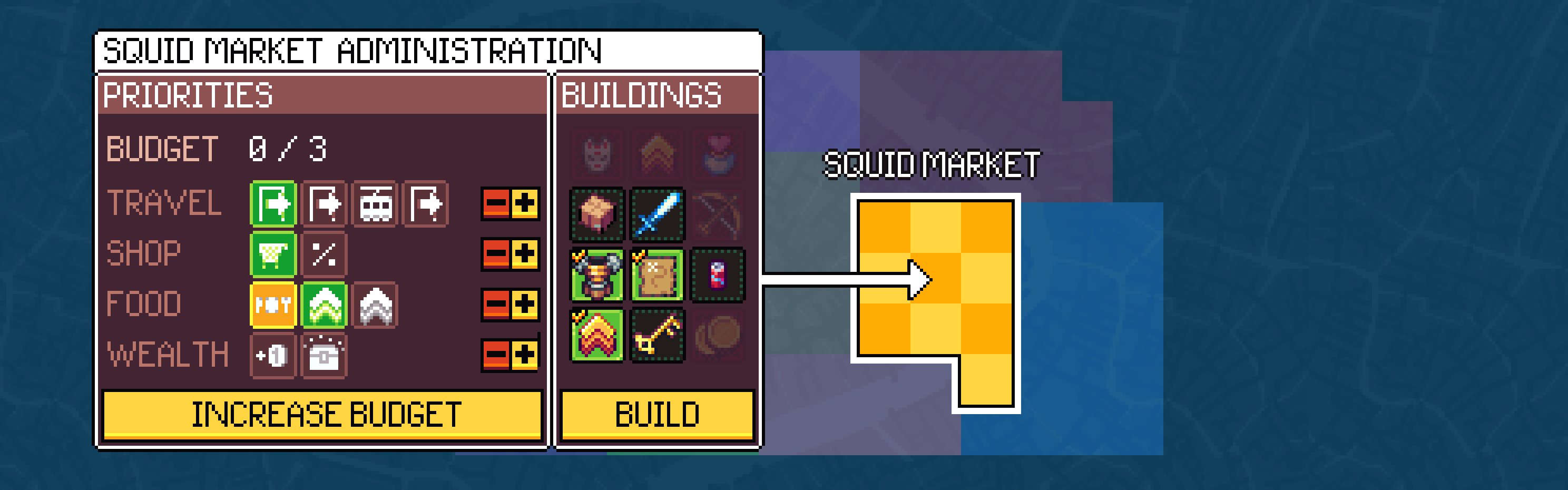
Then the buildings started having more specific effects. Some gave you more gold, some increased XP drops, and others improved your loot while also making the district more dangerous. You could build them in each district and create your own little strategy.
Except, the strategy was not very interesting. If gold was useful, why wouldn’t I just build the gold building everywhere? There were lots of systems to think about, but I couldn’t find many decisions that felt… meaningful. I even added resources like food and water, and buildings that needed to be connected to a power source to work!
It was becoming a proper city-management game, with all the complexity that comes with it. But that wasn’t really what Tenjutsu was about.
I was trying very hard to make the building part strategically deep, when the game’s main appeal was supposed to be fighting through the city.
The open-world problem
The city itself was also designed as an open world. It was divided into districts, and each district was made of smaller levels connected together. You could walk from one level to another without a transition, then move into a neighboring district through a passage. If you found a key later, you could go back and open a door you had passed earlier.
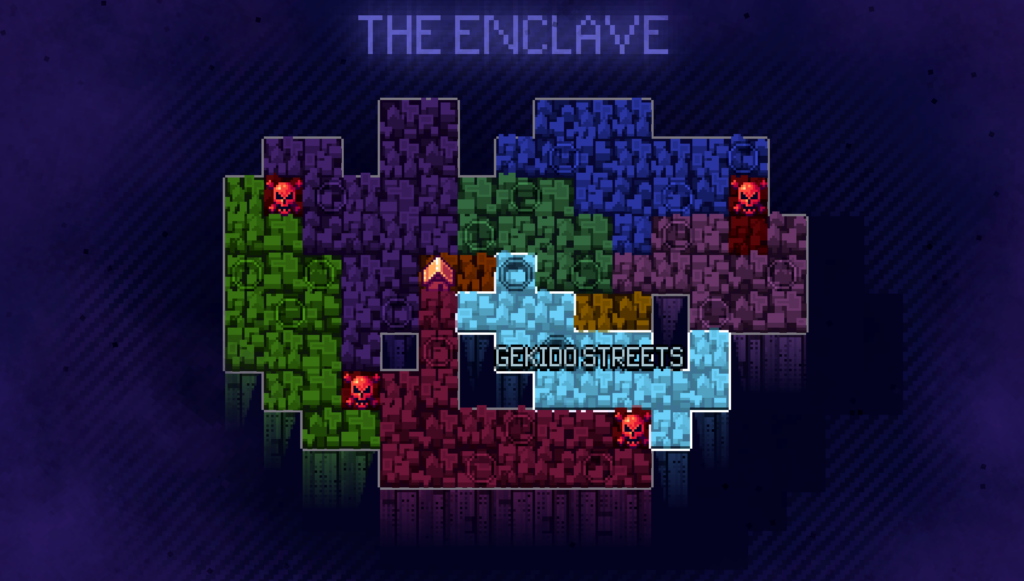
This was technically interesting, and it took me a lot of time to build. The game could save the state of a level, so if you returned, it would still be exactly as you had left it. I was quite proud of that system, woohoo look at me, I implemented a save system! But any dev out there knows how horrible state saving can be, when not properly anticipated. Anyway.
There was one small problem: going back wasn’t fun.
Once you had cleared a district, it stayed cleared. The enemies were gone, so there was no combat and not much else to do. Sometimes you would find a key and have to walk all the way back through empty levels to open a door or a chest you had left behind. It added a lot of backtracking, but not much gameplay.
I spent a loooong time trying to make this cool open-world structure interesting. The problem wasn’t that I couldn’t implement it. I had implemented it and it worked perfectly. I just couldn’t find a good reason for the player to use it.
Eventually, I made a difficult decision: when you leave a district, you can’t go back. If you didn’t open that chest or find that key, it’s gone. I joked with a colleague that I had finally invented successive levels in my video game.
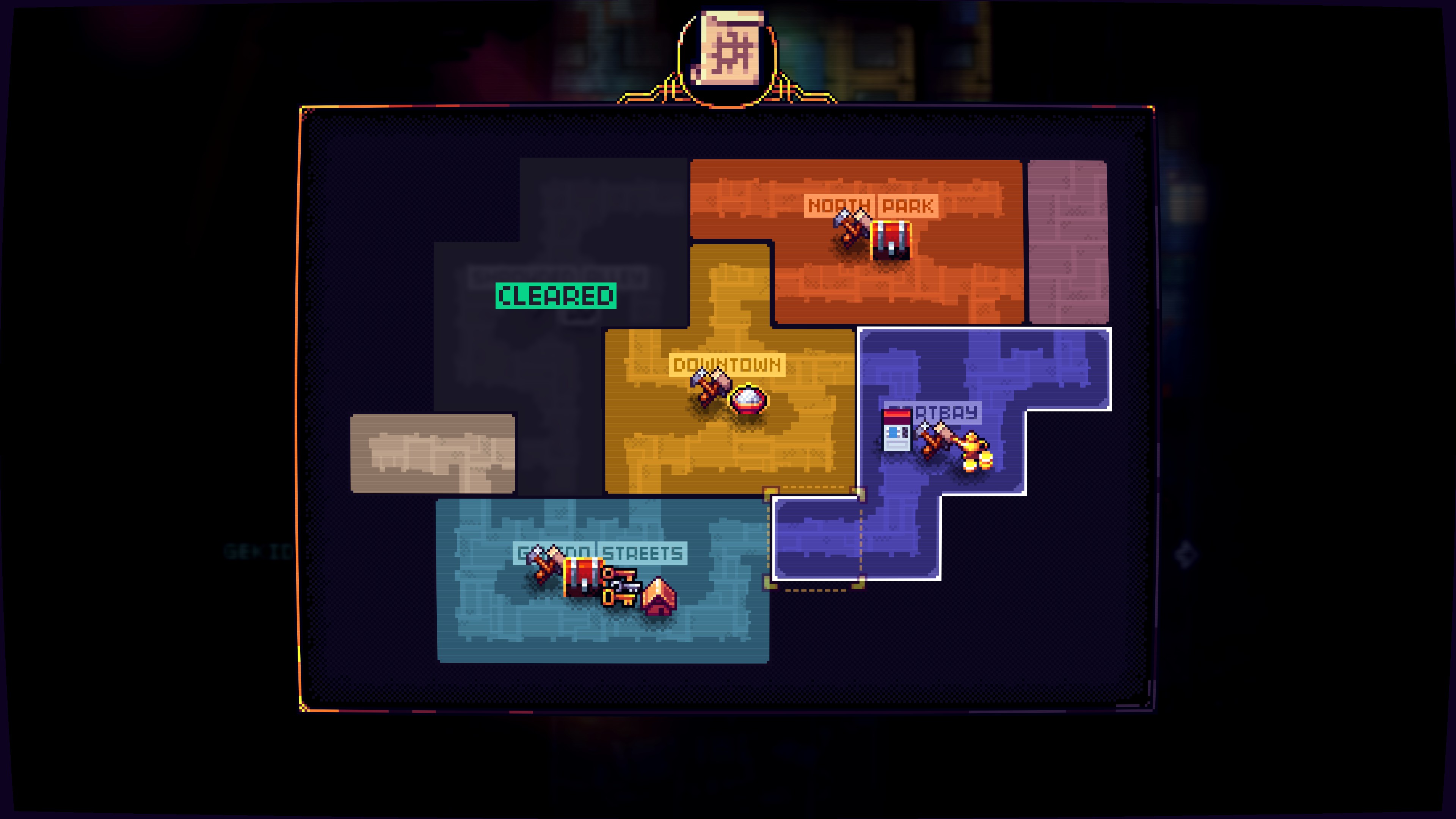
And then the game immediately started making more sense. Leaving a district became a real decision. If I was short on keys, I had to pay attention and prepare for the next one. The world became less complicated, and the run became more focused.
A subway map is still a city
Once I had removed the need to walk back and forth between districts, I could also let go of the idea that they had to be physically next to each other. Before, the map had to be a dense grid of levels that touched one another, because you needed to walk from one to the next.
Now I could represent the city as a network of subway stations. A district could connect to another district even if they weren’t side by side on a map. That made the city easier to generate, and gave me more freedom to decide which areas were connected.
A fun fact (which I didn’t find that fun when I realized it), one of the very early prototypes of the Tenjutsu was a subway network of interconnected stations. So yeah, sometimes you just have to go in circles I guess.
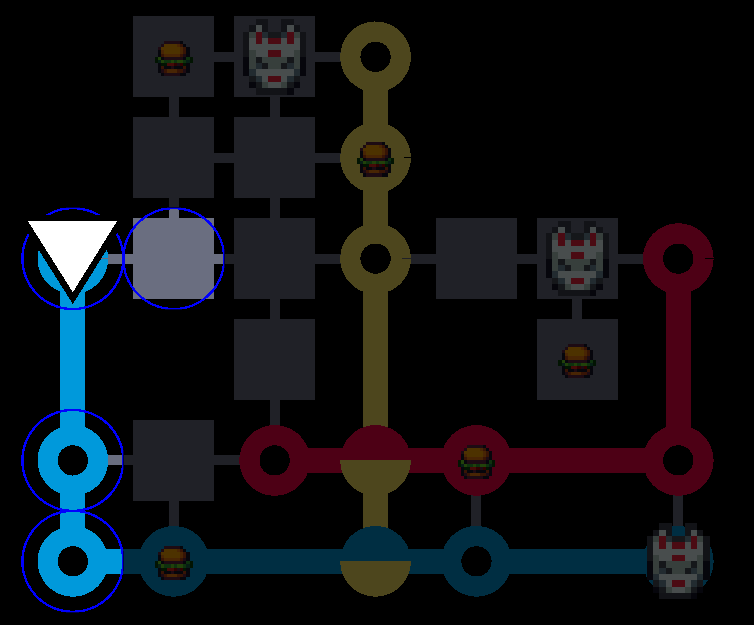
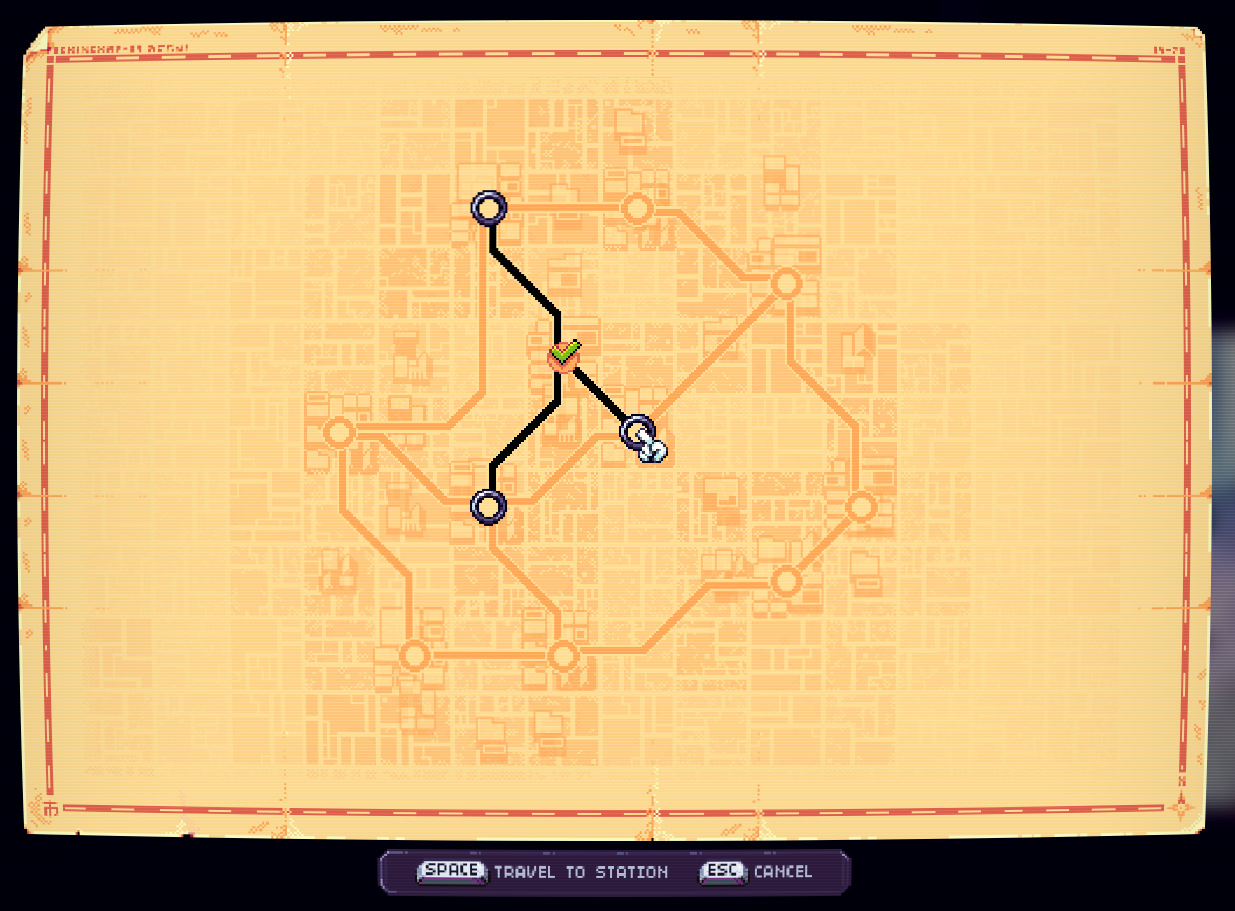
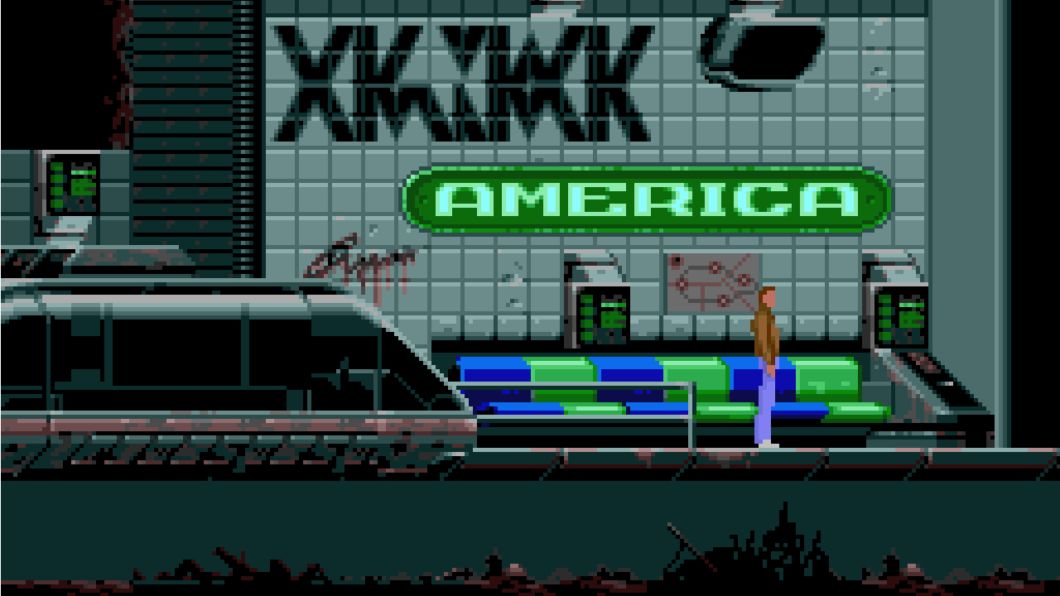
It also led to new things that weren’t in the original plan, including subway sequences (remember Flashback?) that help connect parts of the game. Sometimes dropping an idea doesn’t just remove a problem. It opens space for other solutions.
The game still lets you choose which districts to explore, and the three major bosses can still be defeated in the order you want. That’s another early idea I tried to stick to: you choose who to fight first, and who becomes your final boss. I wanted to avoid the usual roguelite problem where you can only practice against the last boss after surviving the whole run. That idea is still there, but it ended up in a much more structured form.
The city builder I imagined at the beginning is mostly gone. In its place is a simpler map, made of districts and connections, with some of the freedom I wanted still intact.
It took me around thirty eight (!!) versions of the city to get there. I kept trying to make the original idea work, adding more systems and more complexity, until I finally asked myself if all of that was really the point of the game.
Sometimes you can spend a long time building a very complicated solution, only to end up with something that sounds almost stupidly simple. In this case, it was a subway map, and a rule that says: when you leave a district, you leave it behind.
And, somehow, that works much better.
Remember to wishlist the game, or simply tell about it to your friends/community. You already know how important this is, but hey ❤︎ Take care.